retroELOnews / El Enigma de «DEVIL’S RIFF»: El misterioso proyecto cinematográfico de ELO
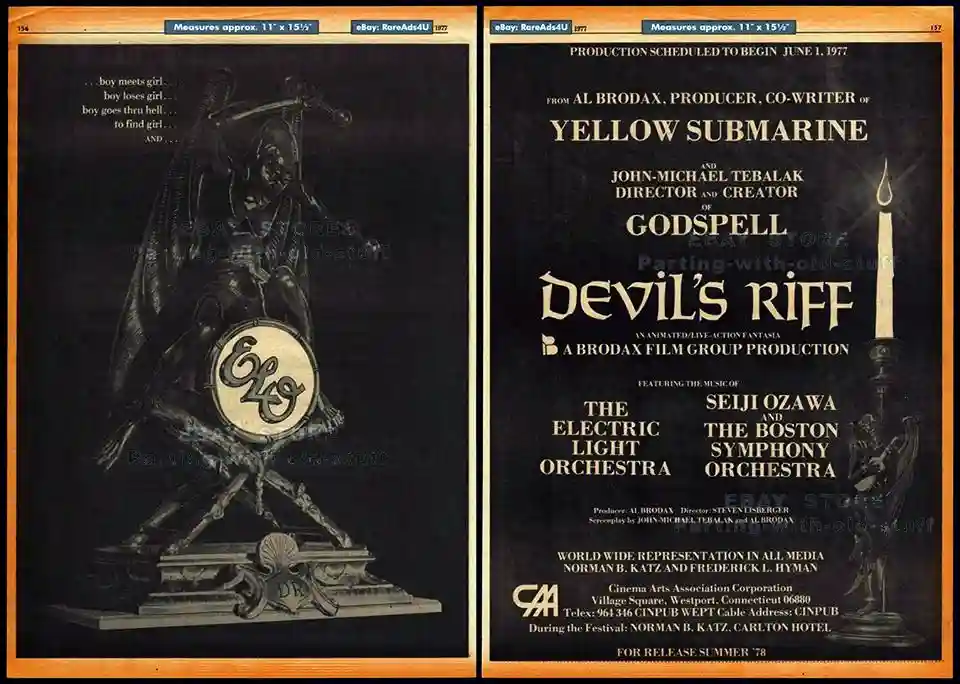
En 2009 nos llamó la atención una extraña publicidad aparecida en Variety: una película titulada Devil’s Riff, con música de ELECTRIC LIGHT ORCHESTRA, acompañada por la inquietante imagen de una criatura tocando un tambor con el símbolo de ELO. Años después, nuevas investigaciones nos permiten reconstruir parte de la historia de aquella película que nunca llegó a realizarse y su posible relación con material musical que ELO recuperaría décadas más tarde.
Lo que parece estar detrás de «Devil’s Riff»
Devil’s Riff fue en la realidad el título de un proyecto cinematográfico que nunca llegó a realizarse. No fue simplemente un título inventado posteriormente para una grabación de ELECTRIC LIGHT ORCHESTRA.
Fue un proyecto cinematográfico concebido como una mezcla de imagen real y animación, y las referencias contemporáneas lo relacionaban con los equipos creativos de Yellow Submarine y Godspell. Los anuncios de la época promocionaban expresamente la participación musical de ELECTRIC LIGHT ORCHESTRA.

Esto hace especialmente significativa la imagen de «THE QUICK» que no parece representar, para nada, la portada de un lanzamiento oficial de ELO, sino una recreación/interpretación gráfica moderna y reciente, seguramente recreada con IA de aquel proyecto. No existe evidencia de que existiera en 1976 un álbum oficial titulado Devil’s Riff – Original Soundtrack con esa portada ni con ninguna otra. Lo que sí está documentado son los anuncios cinematográficos de ese proyecto.
La sección rápida de lo que posteriormente se publicaría como «THE QUICK AND THE DAFT» parece proceder de material compuesto/grabado para el proyecto cinematográfico inacabado Devil’s Riff. Ese material, asociado originalmente al proyecto cinematográfico, acabaría siendo conocido como «The Quick» y posteriormente se combinaría con «Daft As A Brush».
Y aquí entra «THE QUICK»
La conexión con «THE QUICK AND THE DAFT» es particularmente interesante.
La investigación reciente sobre las cintas y descartes de ELO apunta a que la parte rápida «THE QUICK» procede de una idea musical asociada al proyecto Devil’s Riff. De hecho, una reconstrucción de la cronología de las grabaciones sitúa esa pieza en el entorno de las sesiones de 1976/77, mientras que la otra parte, «DAFT AS A BRUSH», tiene una historia diferente.
La frase: «El título original de la sección rápida que más tarde se combinó con “DAFT AS A BRUSH» era simplemente Devil’s Riff es plausible y coherente con la evidencia disponible, pero en realidad no se ha localizado una fuente primaria de ELO que reproduzca literalmente esa frase como título oficial de la cinta. Parece proceder de la identificación posterior de material de archivo y de la investigación de los FANS coleccionistas.
Una conexión todavía más importante: «SURRENDER»
Aquí tenemos una pieza de información que encaja extraordinariamente bien.
Todo apunta a que JEFF LYNNE, según unas notas de A NEW WORLD RECORD, sugiere que «SURRENDER» había sido escrita para una película que finalmente no salió adelante, y ésta podría ser Devil’s Riff. Las investigaciones posteriores de los seguidores han relacionado ese proyecto con Devil’s Riff. Una discusión reciente sobre las cintas de ELO identifica específicamente las sesiones de febrero de 1977 como el momento en que el grupo comenzó a trabajar en «SURRENDER» para la película.
Así que, en base a esto, podemos establecer probablemente una especie de cadena:
DEVIL’S RIFF (proyecto cinematográfico)
↓
Música de ELO prevista para la película
↓
Tema instrumental asociado al proyecto → «Devil’s Riff» / posteriormente «The Quick»
↓
«Surrender» también relacionada con el proyecto
↓
Película cancelada
↓
Material musical reaprovechado años después
Y esto último es importante porque «THE QUICK AND THE DAFT» no apareció originalmente como tal en 1977. Fue publicado oficialmente en la edición de 2007 de OUT OF THE BLUE como tema adicional. Las discografías lo identifican como bonus track de esa reedición.
La investigación sobre los outtakes de ELO sostiene que la parte rápida de lo que finalmente conocemos como «THE QUICK AND THE DAFT» procede de un periodo muy anterior a su publicación. Pero los estudios de los archivos de ELO indican que la grabación de la sección rápida se remonta a una época anterior, y que posteriormente fue unida a «DAFY AS A BRUSH».
Aquí está probablemente la clave de la historia. «THE QUICK AND THE DAFT» parece ser el resultado de unir dos piezas procedentes de momentos/proyectos diferentes:
- The Quick: material rápido relacionado con el antiguo proyecto Devil’s Riff.
- Daft As A Brush: otro instrumental de las sesiones de ELO, cuya historia es más compleja y que fue posteriormente combinado con el primero.
Un investigador que ha trabajado recientemente con estas grabaciones señala incluso que las dos partes de «THE QUICK AND THE DAFT» pueden separarse perfectamente a partir de las fuentes existentes. También señala que «DAFT AS A BRUSH» tuvo dos encarnaciones distintas, una relacionada con OUT OF THE BLUE y otra con DISCOVERY.
Eso explicaría por qué el resultado final de 2007 puede sonar como una pieza relativamente extraña y poco integrada. No nació necesariamente como una composición única con ese título, sino que se ensamblaron materiales de distintas épocas.
Un detalle fascinante sobre la película
La información disponible sobre Devil’s Riff indica que la película habría sido una fantasía híbrida de acción real y animación, algo bastante ambicioso para mediados de los años 70. La publicidad contemporánea la vinculaba directamente a los creadores de Yellow Submarine y Godspell, y anunciaba la música de ELO.
Por eso el proyecto resulta especialmente atractivo dentro de la historia de ELO: habría sido una oportunidad para que JEFF LYNNE llevara su concepción de rock+orquesta+elementos visuales fantásticos a una película varios años antes de XANADU.
Y existe una curiosa consecuencia: si el proyecto hubiera seguido adelante, posiblemente ELO habría tenido una auténtica banda sonora cinematográfica en 1976/77, antes de que LYNNE se involucrara en XANADU.
La imagen de esa supuesta portada se puede considerar como una recreación artística del proyecto cinematográfico inacabado Devil’s Riff, para el que ELECTRIC LIGHT ORCHESTRA llegó a preparar material musical. Nunca como la portada original de la banda sonora.
Una reconstrucción posterior de los aficionados sobre esta película añade un argumento bastante concreto pero sin base documental que permita confirmarlo: Se trataría de un personaje que entra en el inframundo intentando recuperar/rescatar a su amada.
En la investigación además aparece la afirmación de que ELO iba a aportar aproximadamente la mitad de la música, mientras que la otra parte correspondería a Seiji Ozawa y la Boston Symphony Orchestra.


ELOSPAIN:
In 2009, an unusual advertisement in Variety caught our attention: a film entitled Devil’s Riff, featuring music by ELECTRIC LIGHT ORCHESTRA, accompanied by the unsettling image of a creature playing a drum bearing the ELO symbol. Years later, further research has allowed us to reconstruct part of the story behind that film, which was never made, and its possible connection with musical material that ELO would revisit decades later.

What appears to be behind “Devil’s Riff”
Devil’s Riff was, in reality, the title of a film project that was never completed. It was not simply a title invented later for an ELECTRIC LIGHT ORCHESTRA recording.
It was conceived as a mixture of live action and animation, and contemporary references associated it with the creative teams behind Yellow Submarine and Godspell. Advertisements at the time explicitly promoted the musical involvement of ELECTRIC LIGHT ORCHESTRA.
This makes the image of “THE QUICK” particularly significant. It does not appear to represent the cover of an official ELO release at all, but rather a recent graphic recreation or artistic interpretation of that project, most likely recreated with AI. There is no evidence that an official album entitled Devil’s Riff – Original Soundtrack existed in 1976, either with that cover or any other. What is documented are the contemporary film advertisements for the project.
The quick section of what would later be released as “THE QUICK AND THE DAFT” appears to originate from material composed/recorded for the unfinished Devil’s Riff film project. This material, originally associated with the film project, would eventually become known as “The Quick” and later be combined with “Daft As A Brush.”

And here comes “THE QUICK”
The connection with “THE QUICK AND THE DAFT” is particularly interesting.
Recent research into ELO’s tapes and outtakes suggests that the fast section, “THE QUICK,” originated from a musical idea associated with the Devil’s Riff project. A reconstruction of the recording chronology places the piece in the 1976/77 period, while the other section, “DAFT AS A BRUSH,” has a different history.
The statement that “the original title of the fast section later combined with ‘DAFT AS A BRUSH’ was simply ‘Devil’s Riff’” is plausible and consistent with the evidence available, but no primary ELO source has been located that reproduces that wording literally as the official title of the tape. It appears to have originated from the subsequent identification of archival material and research carried out by fan collectors.

An even more important connection: “SURRENDER”
Here we have a piece of information that fits remarkably well.
According to notes associated with A NEW WORLD RECORD, JEFF LYNNE apparently suggested that “SURRENDER” had been written for a film that ultimately never came out, and that film could have been Devil’s Riff. Subsequent research by fans has connected the project with Devil’s Riff. A recent discussion concerning ELO’s tapes specifically identifies the February 1977 sessions as the point at which the band began working on “SURRENDER” for the film.
Based on this, we can probably establish something resembling the following chain:
DEVIL’S RIFF (film project)
↓
ELO music intended for the film
↓
Instrumental associated with the project → “Devil’s Riff” / later “The Quick”
↓
“Surrender” also associated with the project
↓
Film cancelled
↓
Musical material reused years later
And the last point is important because “THE QUICK AND THE DAFT” did not originally appear as such in 1977. It was officially released as a bonus track on the 2007 edition of OUT OF THE BLUE. Discographies identify it as a bonus track from that reissue.
Research into ELO’s outtakes indicates that the fast section of what we eventually came to know as “THE QUICK AND THE DAFT” dates back much further than its eventual release. Studies of ELO’s archives indicate that the recording of the fast section originated in an earlier period and that it was subsequently joined to “DAFT AS A BRUSH.”
This is probably the key to the story. “THE QUICK AND THE DAFT” appears to be the result of combining two pieces originating from different periods/projects:
The Quick: fast-paced material associated with the old Devil’s Riff project.
Daft As A Brush: another instrumental from ELO’s sessions, whose history is more complex and which was later combined with the first.
One researcher who has recently worked with these recordings has even pointed out that the two sections of “THE QUICK AND THE DAFT” can be clearly separated using the surviving sources. The same research indicates that “DAFT AS A BRUSH” had two different incarnations, one associated with OUT OF THE BLUE and another with DISCOVERY.
This would explain why the final 2007 version can sound like a somewhat unusual and loosely integrated piece. It may not have originated as a single composition under that title, but rather as an assembly of material from different periods.

A fascinating detail about the film
The information available about Devil’s Riff indicates that the film would have been a live-action/animation fantasy hybrid, something quite ambitious for the mid-1970s. Contemporary advertising linked it directly to the creators of Yellow Submarine and Godspell, and announced music by ELO.
This makes the project particularly intriguing within the history of ELO: it would have offered JEFF LYNNE an opportunity to bring his conception of rock, orchestral elements and visual fantasy to a film several years before XANADU.
And there is an intriguing consequence: had the project gone ahead, ELO might have had a genuine film soundtrack as early as 1976/77, years before LYNNE became involved with XANADU.
The image of the supposed album cover should therefore be regarded as an artistic recreation of the unfinished Devil’s Riff film project, for which ELECTRIC LIGHT ORCHESTRA did prepare musical material. It should never be presented as the original cover of the soundtrack.
A later reconstruction by fans of the film adds a fairly specific, but undocumented, storyline that cannot currently be confirmed: the story would have involved a character entering the underworld in an attempt to recover or rescue his beloved.
The research also contains the claim that ELO was expected to provide approximately half of the music, while the other half would have been supplied by Seiji Ozawa and the Boston Symphony Orchestra.