
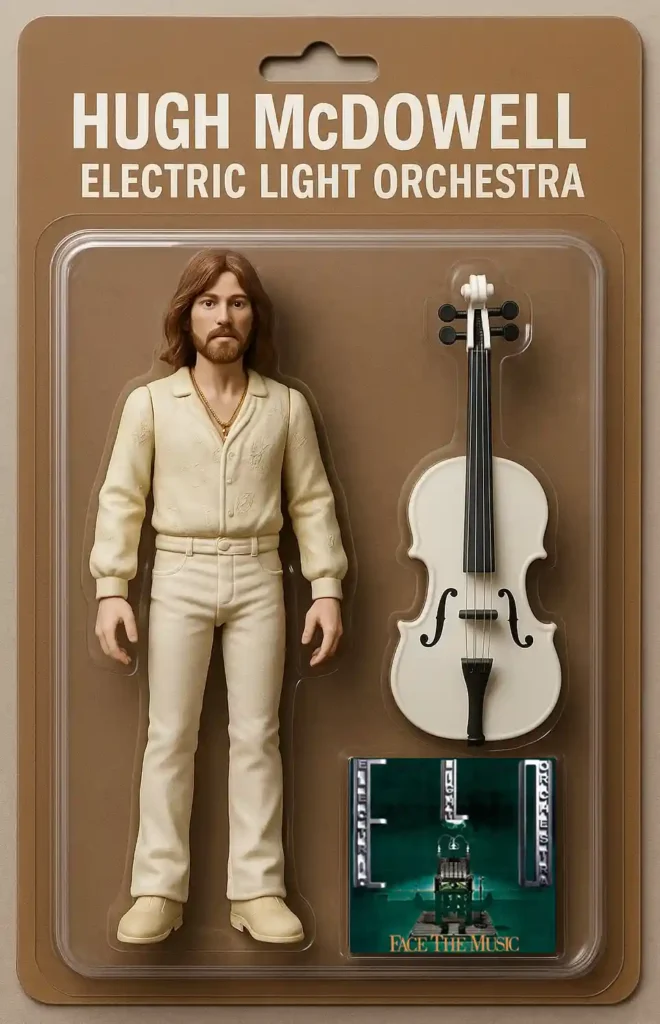
La figura de acción de HUGH McDOWELL
Un componente de ELO que no podemos obviar en formato figura de acción, con más o menos acierto en ELOSPcom es HUGH McDOWELL. Otro componente de ELO clave, carismático y virtuoso. Reconocido por su energía en escena y su papel clave en el sonido orquestal de esta banda. Su presencia fue fundamental en los primeros años, cuando buscaban fusionar rock con música clásica de forma innovadora.
McDowell se unió a ELO en el año 1972, durante la gira del primer álbum. Formó parte del núcleo de violonchelos que daba a la banda su sonido tan característico.
Era conocido por su técnica impecable y su forma física, moviéndose con el violonchelo y dándole uso cual si fuese una guitarra eléctrica más. Su presencia escénica ayudó a definir la estética de ELO en los 70. Participó en grabaciones y giras clave durante el ascenso internacional del grupo y hasta llegó a denominársele el primer chelista de rock’n’roll del mundo.
En 1972, tras la marcha de Roy Wood, McDowell dejó ELO brevemente para unirse a Wizzard, pero regresó en 1973 y permaneció hasta 1979.
Tras su etapa en la banda: Participó en proyectos como Radio Stars y Orkestra (formado por exmiembros de ELO). También trabajó en música clásica, colaboraciones y composición. Fue activo como intérprete hasta 2018.
Su legado permanece en los discos clásicos de ELO y en la memoria de quienes disfrutaron de su energía única.
ELOSPAIN:
A member of ELO that we cannot overlook in action-figure form on ELOSPcom is HUGH McDOWELL. Another key, charismatic, and virtuosic member of ELO, recognized for his onstage energy and his crucial role in shaping the band’s orchestral sound. His presence was fundamental in the early years, when the group sought to fuse rock with classical music in an innovative way.
McDowell joined ELO in 1972, during the tour for the first album. He became part of the cello core that gave the band its unmistakable sound.
He was known for his impeccable technique and physical performance, moving with the cello and playing it almost as if it were an electric guitar. His stage presence helped define ELO’s visual aesthetic throughout the 1970s. He took part in key recordings and tours during the band’s international rise and was even described as the world’s first rock ’n’ roll cellist.
In 1972, following Roy Wood’s departure, McDowell briefly left ELO to join Wizzard, but returned in 1973 and remained with the band until 1979.
After his time with ELO, he participated in projects such as Radio Stars and Orkestra (formed by former ELO members). He also worked in classical music, collaborations, and composition. He remained active as a performer until 2018.
His legacy lives on in ELO’s classic albums and in the memory of those who experienced his unique energy.